The piece of barely managed mayhem now unfolding at the Ethel Barrymore Theater, Peter Pan Goes Wrong, speaks louder than its British producers might even realize to the political situation on this side of the pond. The Mischief Company’s popular blend of literary classics with stagecraft gone awry and snarling interpersonal meanness attracts huge audiences across the English-speaking world, perhaps because it feeds a certain appetite for bullying weaker members of society, taking physical risks, and letting people in charge push others around.
Peter Pan Goes Wrong is the latest Mischief Company project to arrive in New York. Now a worldwide conglomerate, the troupe, founded a decade ago by a bunch of twenty-somethings, has presented mangled versions of theatrical favorites onstage and on television, such as The Play That Goes Wrong, a murder-mystery spoof, and A Christmas Carol Goes Wrong. The members of the ensemble, now 30-something, met and began collaborating at the London School of Music and Dramatic Art (LAMDA), one of Britain’s primary training academies for performers. (Grad Benedict Cumberbatch is the president of LAMDA’S Board of Trustees.) The Play That Goes Wrong, Mischief’s initial project, won Britain’s Olivier Award as Best New Comedy; it ran on Broadway for two years, starting in 2017, and then set up at New World Stages, around the corner from the theater district, where it continues to delight audiences with its physical and insult comedy.
At a certain level, this Peter Pan, a play within a backstage drama that spills into the auditorium, is a romp for children, and Sunday’s matinee crowd had a good population of little ones having a wonderful time. (The sweet spot for kids is probably between 6 and 13; it helps if they’re old enough to read. The show is very noisy and sometimes brutal — a lot of the humor comes from cruel personal messages inadvertently blasted across loudspeakers and people who suddenly crash-land, so leave the very youngest folks at home.)
I’m currently a senior citizen surviving on Social Security and occasional Zelle deposits from Village Voice Media, and the source material for this production holds a special place in my head and my heart. J.M. Barrie (1860–1937) launched the story in 1904, and it became a fabulously successful Broadway offering, starring Mary Martin, in 1954, with music by Morris “Moose” Charlap and Jule Styne and lyrics by Carolyn Leigh, Betty Comden, and Adolph Green. I saw it on TV: the Tony-winning production was broadcast several times, including a 1960 early colorcast, the first Broadway musical to be televised with its cast and crew intact. I had the record and knew the lyrics to all the songs. Remember “Never smile at a crocodile”?
The actors playing these roles are double- and triple-cast: the performers whose photos grace Playbill fill dozens of speaking parts and serve as technicians wielding buzz-saws and fire extinguishers.
Mischief’s production — now almost 10 years old and seasoned with runs in London and Edmonton, Alberta, and as a BBC Television broadcast — has a few songs, but not the ones I learned, and not memorable. It does have, until the end of this month, adorable New Yorker Neil Patrick Harris, as much an icon to a certain generation of theater and television watchers (beginning with Doogie Howser M.D.) as Mary Martin’s Peter Pan was to mine. Harris, one of the only Americans on the stage, starts off reading narration in rhymed couplets and tossing fairy dust into the air from a chair off to the side, but soon falls full-tilt into the demanding hijinks.
The text takes off from the Barrie play. I found myself reciting lines along with the actors, and recalled that I was part of a production of Peter Pan in 1959, at a children’s theater on Long Island. I understudied the dog Nana, who serves as nursemaid for the three Darling children, Wendy, Peter, and Michael, before they’re spirited away to Neverland by a night visitor, Peter himself, who breaks in through a dormer window while looking for his shadow.
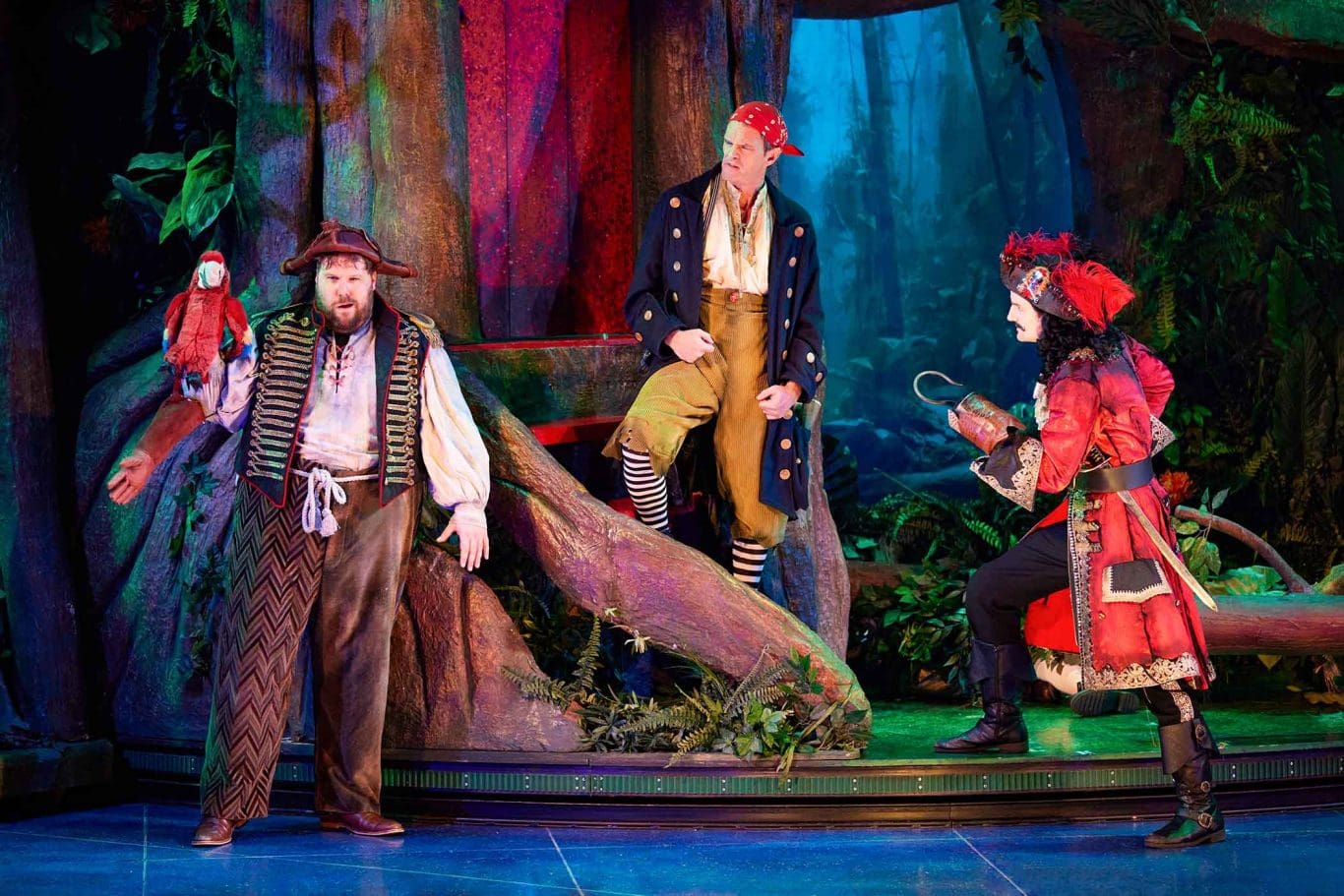
The actors playing these roles, members of the fictional Cornley Youth Theatre, are double- and triple-cast: the performers whose photos grace Playbill fill dozens of speaking parts and serve as technicians wielding buzz-saws and fire extinguishers. The black-clad techs control the members of the troupe who actually go aloft on flying apparatus designed by Peter Foy, the same guy who sent Mary Martin up in 1954; the stage crew here are visible, and sometimes called in to replace damaged actors. Several performers, also the writers of this version of the story, bring to life members and directors of the Conley group: Henry Lewis (in real life, artistic director of Mischief) plays Robert Grove, head of the Conley theatre, and also appears onstage as portly Nana the dog, a tree, and a pirate. He dragoons his painfully shy niece, Lucy, into the cast to play one of Peter Pan’s Lost Boys, with catastrophic, then triumphant, results. Also triumphant is low-key Matthew Cavendish as Max, nephew of the play within the play’s “angel,” who put up $80,000 to get the show on its feet. A quiet kid playing one of the Darling children, and then the crocodile, Max is maligned and insulted but turns out to be the warm heart of the enterprise.
Nancy Zamit, another co-founder of Mischief, plays Annie Twilloil playing three major female roles — the mother, the maid, and the fairy Tinker Bell — requiring breakaway costumes in order to arrive on time from one encounter to the next. The outfits often malfunction, with unexpected consequences, as when the light bulbs on the fairy costume short-circuit the theater’s electrical system, leaving us all in the dark. Zamit and Charlie Russell (another co-founder, who plays Wendy Darling and gets up to some sexual hanky-panky with various members of the cast) hold down the distaff side of the undertaking. Ellie Morris’s Lucy, as a Lost Boy, breaks a leg but ultimately steps in for Neil Patrick Harris’s narrator.
It’s important to get to the theater early so you can, first of all, keep an eye on the hilarious technical snafus that start piling up long before the lights go down. Second, read the Playbill, which, like the one for Les Ballets Trockadero de Monte Carlo, a 50-year-old comic dance troupe in which every performer has triple identities, has two sections: pages about the Cornley Youth Theatre production, with a set of young Brits playing the Peter Pan characters, and a section for the current Broadway show, which provides the actual names and photos of the actors playing those characters in New York. As with the Trocks’ programs, this material sometimes finds its way into narrated announcements — the visual and aural chaos is central to the production.
In the course of reading the very funny Cornley notes, and listening to the Cornley cast reminisce about making live theater on a shoestring, including disasters in past productions because of budget shortfalls (in the midst of the production of Peter Pan, an old show poster accidentally descends from above, reading Jack and the Bean) and fatal pratfalls (the heavy-set assistant director, Robert Grove, played in a fat suit by Henry Lewis, fell on and squashed a younger actor, who ultimately died because Grove’s car, parked in the theater’s loading dock, blocked the arrival of the EMTs), we realize that we are dealing with the deconstruction of a classic: simultaneously watching Barrie’s play and all the behind-the-scenes melodrama that comes with the territory of a community-theater production by young British thespians. The black-clad technical crew is as large as the speaking cast, overseeing explosions and flying and fire and steam and the walking tree. By the end of the two-hour enterprise everything — by which I mean every piece of scenery and the revolving stage itself, which occasionally runs backward — has gone off the rails.
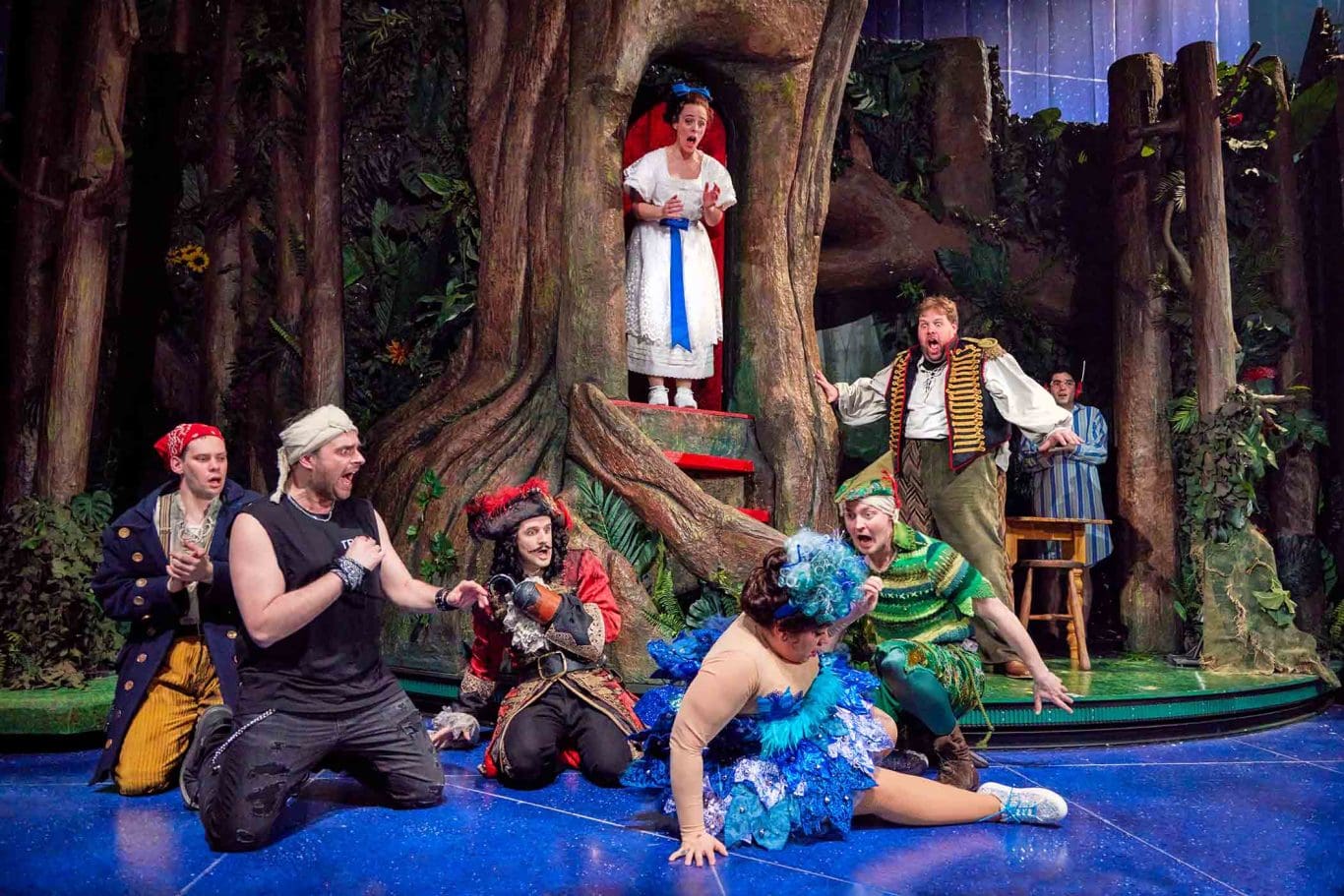
“To die would be an awfully big adventure,” says Peter, when threatened by Captain Hook, played by the same actor, Henry Shields, who opens the show as papa John Darling. An odd sentiment for an ostensible children’s play, but there it is, as well as the collisions of Barrie’s Victorian attitudes with the more liberated adolescent females of the 21st century. Bits of moral suasion surface among scorched-earth static and crashes. Much of the material is tasteless, milking laughs from exposed underwear and mocking kids with learning disabilities. The co-directors discuss situations behind the actors’ backs, but a hand on the wrong knob sends their remarks out into the house: “Jonathan’s playing Peter Pan, and Sandra’s playing Wendy, they shouldn’t be sleeping together,” says one. “Exactly. He’s supposed to be the boy who wouldn’t grow up, not the boy who couldn’t keep it in his pants.”
The “going wrong” of the title includes using similarly miscued audio to reveal inner-sanctum conversations, like a foundering marriage between members of the company, accidentally recited to the general audience by a developmentally delayed kid wearing headphones that are supposed to be feeding him his lines. It will appeal as much to staid adults with affection for Barrie’s material as to kids raised almost exclusively on Jackass and other violent stories on screens. Children infatuated with theater, and adults who care about and once were those children, will find illumination here, as well as slapstick madness and a deeper understanding of how interpersonal cruelty escalates into fascism. ❖
Peter Pan Goes Wrong
Ethel Barrymore Theatre
243 West 47th Street
Elizabeth Zimmer has written about dance, theater, and books for the Village Voice and other publications since 1983. She runs writing workshops for students and professionals across the country, has studied many forms of dance, and has taught in the Hollins University MFA dance program.
The post Review: ‘Peter Pan Goes Wrong’ Bludgeons With Wit appeared first on The Village Voice.





0 Commentaires